
Loop Drift: Why Production AI Agents Get Stuck and How to Stop Them
TL;DR
Loop drift is a failure mode where AI agents transition from efficient behaviour into repetitive, self‑reinforcing loops that burn money and quietly degrade reliability. Unlike classic infinite loops, these patterns are statistical, trigger‑based and often masked by "healthy" metrics. Gateway‑layer governance with Trace IDs, loop‑aware policies and step/cost circuit breakers is the only reliable way to detect and stop loop drift before it hits finance, SRE and compliance
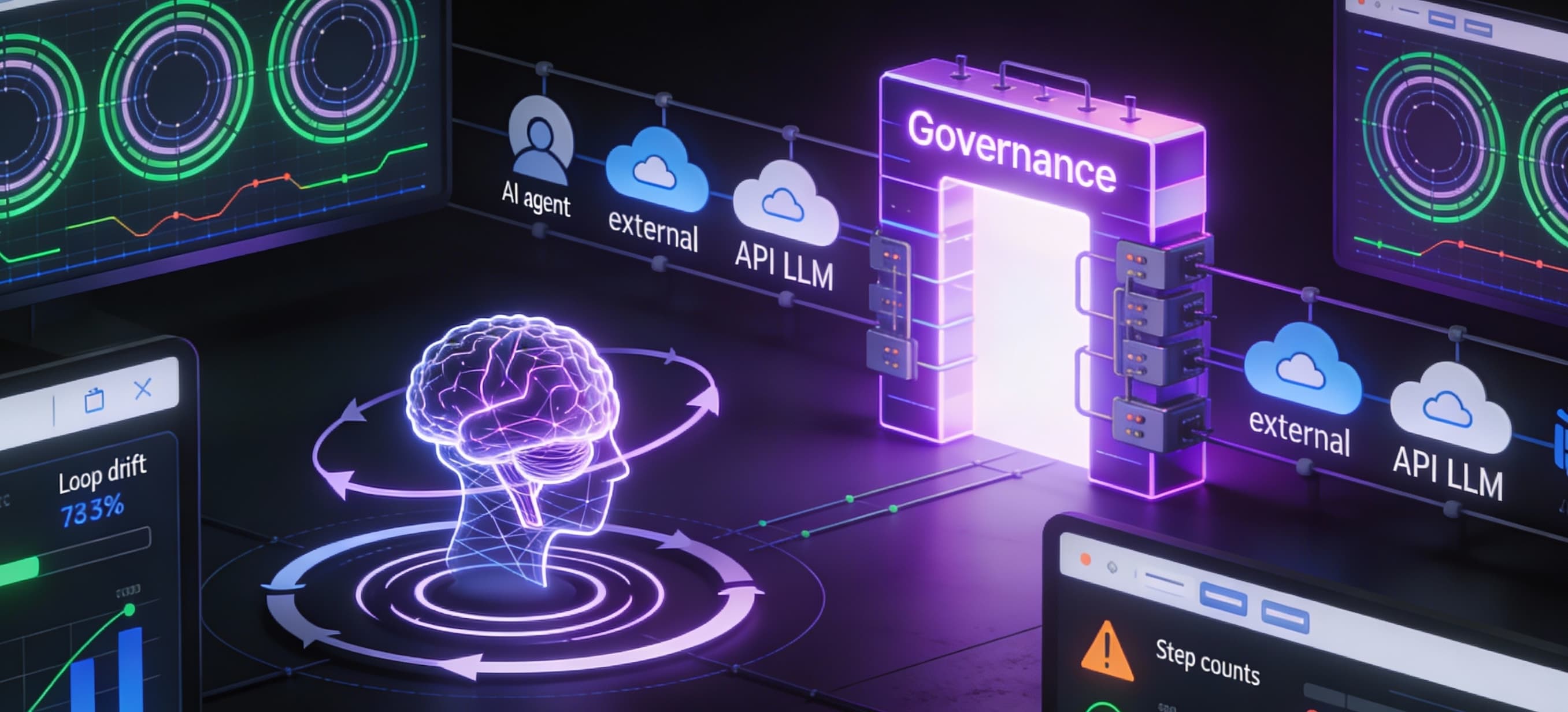
In 2025, a production AI agent deployment ran for 11 consecutive days in an undetected loop, accumulating a $47,000 bill before engineers noticed the pattern. The system was not technically failing — APIs returned 200s, logs looked normal, and dashboards showed "activity". Yet every hour, the agent was repeating near‑identical work with minor variations, invisible to standard monitoring setups 1.
Enterprises deploying AI agents are discovering a new class of failure that does not show up in traditional observability dashboards: loop drift. Unlike deterministic infinite loops in code, loop drift is statistical, context‑dependent and often profitable in the short term, making it nearly impossible to catch with conventional monitoring.
Research shows that around 12% of production AI agent workflows exhibit some form of repetitive behaviour2 and 73% of enterprises lack real‑time cost tracking for their AI systems3. The combination creates a perfect storm: agents can burn thousands in cloud spend while appearing operationally healthy.
This post explains what loop drift is, why it happens, how to detect it and which governance patterns actually work in production — including how a governance gateway like Aqta stops 11‑day loops before finance sees them.
What is loop drift?
Loop drift is a failure mode where an AI agent gradually transitions from efficient, goal‑directed behaviour into repetitive, self‑reinforcing loops. Unlike a classic infinite loop in code, loop‑drift patterns are:
- Statistical rather than deterministic – they emerge from probabilistic model outputs, not hardcoded logic
- Trigger‑based – only appearing under specific input conditions or environmental states
- Often profitable in the short term – more user engagement, more API calls, more "activity" — masking the underlying issue
Instead of failing loudly with an error code, the system continues to produce outputs — just not the ones you intended and in ways that are extremely difficult to trace back to a single defect.
Where loop drift shows up in production
Common places loop drift emerges in enterprise stacks:
Customer support agents
Re‑opening or re‑routing tickets instead of resolving root causes, creating duplicate work and customer frustration.
Data‑enrichment agents
Re‑fetching the same records with minor variations, multiplying database load and API costs.
Workflow orchestrators
Re‑running subflows when confidence scores fluctuate around decision thresholds, creating exponential retry patterns.
Content generation agents
Iterating endlessly on drafts as feedback loops are misinterpreted, never reaching a final approved state.
In each case, the system is technically functioning — APIs return 200s, logs look healthy, dashboards show "activity". Yet cost, latency and user experience all silently degrade.
Detection challenges: why traditional monitoring fails
Traditional observability tools fail to catch loop drift because:
- The agent is not technically failing — it is executing valid operations with valid responses
- Each iteration produces slightly different outputs, masking the repetitive pattern from simple deduplication logic
- Loops might only manifest under specific conditions, input combinations or load patterns
- By the time humans notice unusual spend or latency, significant costs have already accrued
The $47K loop incident
In the documented GetOnStack case, engineers discovered an 11‑day loop only after reviewing their monthly cloud bill. The agent had been executing what appeared to be legitimate multi‑step workflows, but was actually repeating near‑identical sequences with minor prompt variations. Standard APM tools showed "normal" latency and error rates throughout1.
You need purpose‑built observability that understands agent behaviour patterns, not just API response codes and error rates — and that is exactly what a governance gateway is designed to provide.
Root causes: why loop drift happens
Loop drift is rarely caused by a single bug. It usually emerges from the interaction of three structural forces:
1. Non‑determinism in LLM outputs
Even with temperature set to zero, large language models introduce variance in their outputs. This means the same input can produce slightly different decisions across runs, making it impossible to predict exactly how many steps an agent will take to reach a goal.
2. Reward misalignment
Many agentic systems are implicitly optimised for engagement, token throughput or observable "activity" rather than end‑state success. When an agent's internal reward signal favours doing more over finishing correctly, loops become profitable from the model's perspective.
3. Missing global constraints
Individual tools and sub‑agents typically operate with no shared budget, step limit or risk ceiling. Each component is locally intelligent, but there is no global governance layer to enforce "you may not spend more than $X or take more than N steps per request".
In other words: you have local intelligence without global governance.
The hidden cost: energy and carbon
Loop drift is not just a finance or reliability problem. Every unnecessary agent step is an unnecessary model invocation – and every invocation consumes energy.
In a long‑running loop, the agent may call an LLM hundreds or thousands of times while making no real progress toward its goal. Even when each call is "cheap" in isolation, the aggregate compute adds up quickly in both cloud spend and carbon emissions.
We are not publishing specific CO₂ numbers here — they depend on your cloud region, hardware and model choices — but the direction of travel is clear: suppressing redundant inference reduces both cost and environmental impact.
If you are running agent fleets in production, start by measuring how much of your traffic is loop waste — the cheapest energy and cost to save is the compute you never should have run.
Why debugging loop drift is so hard
When teams finally notice loop drift — usually through unexpected costs or user complaints — they often attempt to debug it like a traditional software issue:
- Pull logs from Datadog, Splunk or CloudWatch
- Search for HTTP errors or spikes in latency
- Try to reproduce the pattern in staging with synthetic inputs
The problem: your logs are event‑centric, not trace‑centric. Individual API calls look fine. What is missing is a coherent narrative that ties together:
- The original user or system trigger
- Each agent decision step and reasoning
- All tool calls, retries and backoffs
- The eventual outcome, total cost and wall‑clock latency
Without that end‑to‑end trace, you are trying to reconstruct agent behaviour from scattered clues across multiple systems — a process that can take days or weeks.
Is your system vulnerable? Quick assessment
If you answer "no" or "not sure" to more than two of these, your agents are likely exposed to loop drift risk:
- ☐Can you trace a single agent request from trigger to final outcome across all tools and APIs?
- ☐Do you have automatic alerts when an agent repeats similar actions beyond an expected threshold?
- ☐Can you cap the number of steps or cost per request without modifying the agent's code?
- ☐Do you have clear kill switches for misbehaving agents in production?
If you checked fewer than 3 boxes, you need loop‑aware governance infrastructure now.
Governance patterns that actually work
Solving loop drift requires governance outside the agent itself. Three patterns stand out in production deployments:
Global step & cost limits
Enforce hard limits on steps, tokens and cost per request at the gateway level, not inside each agent implementation. This creates a single source of truth for "maximum acceptable work per request".
Trace‑centric logging
Assign a single Trace ID that follows every decision, tool call and retry, making loop patterns obvious to both humans and auditors. This is the EU AI Act Article 12 requirement in practice.
Loop‑aware policies
Define policies like "max 3 retries with similar inputs" or "no more than N tool calls in 60 seconds" and enforce them centrally. Crucially, these policies sit outside your application code, so they can evolve independently.
Gateway‑layer detection for loop drift
The most robust place to enforce these patterns is in a governance gateway that sits between your agents and model providers:
Gateway‑Layer Architecture (loop‑aware)
Your Application / Agents
        ↓
  Governance Gateway
    • Trace IDs
    • Loop detection
    • Cost & step limits
    • Policy evaluation
        ↓
Model Providers / Tools
(OpenAI, Claude, Llama, etc.)
Because the gateway sees every request and response across all agents and tools, it is the only layer that can reliably detect and cut off loop drift before it becomes a budget or reliability incident — and it creates the trace‑centric, tamper‑evident logs regulators expect.
What gateway‑layer governance provides
- Unified Trace IDs – every step of agent execution carries the same ID, making loops immediately visible in dashboards
- Real‑time circuit breakers – automatic cutoffs when cost, step count or latency exceed defined thresholds
- Policy enforcement without code changes – rules like "max 10 steps per request" apply across all agents instantly
- Audit‑ready logs – tamper‑evident records that satisfy EU AI Act Article 12 traceability expectations
What to instrument first (next 30 days)
For teams already running agents in production, a pragmatic starting plan:
- Standardise Trace IDs – ensure every request from every agent carries a consistent ID across logs and tool calls.
- Implement soft limits – add alerts (not hard stops yet) for unusually long traces or high‑cost requests.
- Introduce gateway logging – route at least one critical workflow through a governance gateway to get richer, trace‑centric visibility.
- Define loop policies – start with simple rules like "no more than 10 steps per request" or "flag if similar tool calls repeat 3+ times".
You do not need to refactor every agent on day one. You need a choke point where governance can evolve faster than your application code.
The risk of waiting
Every week you run agentic workloads without loop‑aware governance, you are accumulating invisible risk — in cost, reliability and compliance exposure.
Loop drift incidents rarely show up as a single outage. They surface as rising cloud bills, slower customer journeys, duplicate work and harder audits. By the time finance or compliance notices, you have often burned weeks of engineering time and significant budget.
How Aqta helps
Aqta's governance gateway is built specifically to catch and control patterns like loop drift in enterprise AI systems without asking your engineers to re‑instrument every agent.
What Aqta provides
- Transparent Trace IDs across agents, tools and providers
- Loop detection policies tuned for agentic workloads
- Cost and step circuit breakers configurable per use case
- Audit‑ready logs aligned with EU AI Act Article 12 expectations
- Multi‑provider support – works with OpenAI, Anthropic, open‑source models and internal fine‑tunes
The bottom line
Loop drift is not a rare edge case — it is a structural failure mode that emerges from how agentic AI systems are built and deployed. Traditional monitoring tools cannot catch it because they are designed for deterministic software, not probabilistic agents.
The solution is gateway‑layer governance: Trace IDs, loop‑aware policies and circuit breakers that sit outside your application code and scale across all your AI workloads.
That is the layer Aqta is building — the same gateway that underpins our EU AI Act compliance guide.
Aqta is in private beta with design partners preparing for the EU AI Act's August 2026 deadline.
Get in touch →Sources & references
- Towards AI / GetOnStack, "We Spent $47,000 Running AI Agents in Production", documenting an 11‑day loop incident in a production multi‑agent system, 2025.Source ↗
- Wharton Business School, “The Hidden Cost of AI Energy Consumption”, overview of how large‑scale AI inference is driving rapid growth in data centre energy use and why optimisation matters for enterprises.Source ↗
- Fix Broken AI Apps, "Why AI Agents Get Stuck in Loops", analysis showing approximately 12% of production AI agent workflows in financial services exhibit repetitive behaviour patterns, December 2025.Source ↗
- AI Costs, "The AI Agent Cost Crisis: Budget Disaster Prevention Guide", reporting that 73% of enterprises lack real‑time cost tracking for AI systems, leading to budget overruns, July 2025.Source ↗
- EU AI Act (Regulation 2024/1689), Article 12 requirements for record‑keeping and traceability of high‑risk AI systems, including logging of input data, decision outputs and human oversight.Source ↗
For more on Aqta's approach to AI governance visit aqta.ai
About the author
Anya Chueayen is the founder of Aqta, an AI governance platform for enterprise agents. Previously at TikTok, she scaled trust & safety systems and worked on monetisation integrity and AI infrastructure for global platforms.
Anya is based in Dublin where she is building AI governance infrastructure with early design partners in fintech and healthcare, preparing for the EU AI Act's August 2026 deadline.
Published 30 December 2025
Related articles
Read now
Why Enterprise AI Needs Governance Now: The 2026 Compliance Deadline
With the EU AI Act high‑risk obligations taking effect in August 2026, enterprises deploying AI agents need governance infrastructure today.
Read now
The Human Supply Chain Behind AI
As models become commodities and AI‑generated code explodes, the real risk lives in the software and human supply chains beneath them.
Read now
The 2026 AI Bracing: Why Governance is the New Growth Metric
As AI valuations wobble and the EU AI Act bites, governance becomes a core growth metric for AI teams.
Coming soon
EU AI Act Checklist for Agent Deployments
A practical guide to mapping AI Act requirements to runtime governance controls.