
Enterprise AI Governance and The 2026 Compliance Deadline
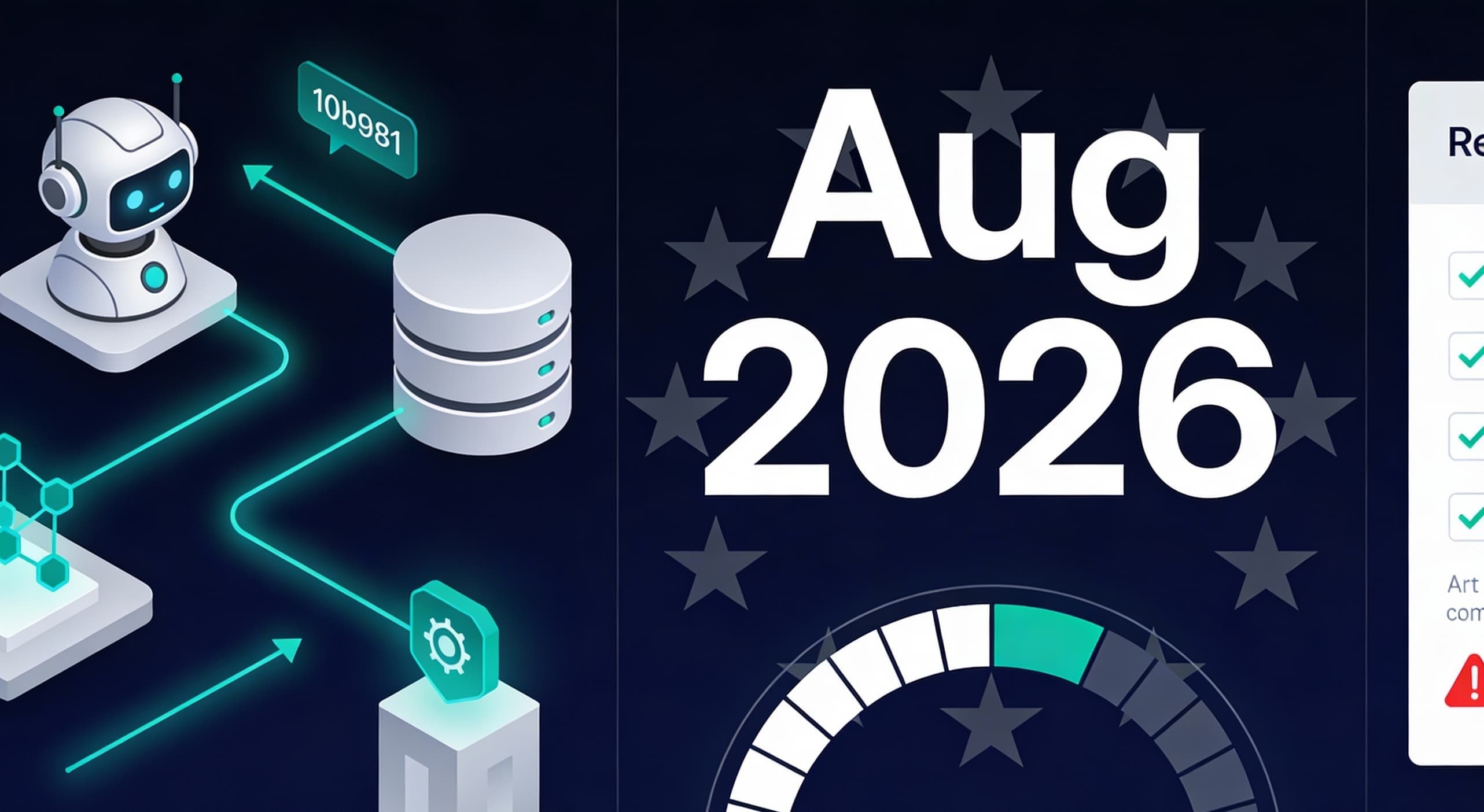
August 2026. That's when the EU AI Act's high-risk obligations kick in.
Most AI companies aren't ready. I know this because I've been asking them. "Show me your audit logs." "Prove your AI isn't discriminating." "Where's your Article 12 compliance?"
Silence. Or worse: "We're working on it."
Here's what changed: In 2023, enterprises built chatbots — systems that answered questions. In 2025, they deployed agents — systems that act autonomously, call APIs, spend budgets, make decisions. But they're still using chatbot-era logging. That's not a gap. That's a compliance disaster waiting to happen.
The agentic surge: by the numbers
The shift is happening faster than many C-suites realise:
| Statistic | Source |
|---|---|
| 79% of organisations have implemented AI agents | Arcade.dev, Dec 2025 |
| 96% of IT leaders plan to expand agent usage in 2026 | PwC / Arcade.dev |
| 43% of companies allocate >50% of AI budgets to agents | Arcade.dev, Dec 2025 |
| 75% of tech leaders cite governance as their #1 concern | Arcade.dev, Dec 2025 |
The economics are clear: as AI becomes cheaper and easier to deploy, enterprises flood their stacks with agents. The challenge is keeping those agents safe, compliant and cost-effective once they are running.
The timeline: August 2026 is the redline
The EU AI Act (Regulation 2024/1689) is phased, but the "high-risk" hammer drops soon. For banks, fintech, healthcare and HR systems deploying AI agents, the clock is already ticking.
| Date | Milestone | Who It Affects |
|---|---|---|
| Feb 2025 | General provisions | All AI system providers |
| Aug 2026 | High-risk obligations | Banks, fintech, health, HR |
| Aug 2027 | Full enforcement | All in-scope AI systems |
200‑odd days until August 2026
That is comfortably under a year. If your credit, onboarding or clinical workflows rely on AI agents, you need to be able to show regulators exactly which agent did what, when, and at what cost — and that you can cut off a misbehaving loop before it turns into an 11‑day, five‑figure incident.
Ireland's Parliament backs the Aug 2026 deadline
Dr Barry McCullagh's Oireachtas Joint Committee on AI report (Dec 2025) recommends establishing a National AI Office by August 2026 for high-risk AI assessments, transparency registers and bias prevention. It emphasises audit trails, human oversight and tamper-evident logs — exactly what enterprise governance infrastructure must deliver.
What the EU AI Act actually requires
Article 12 of the EU AI Act mandates automatic logging for high-risk AI systems. The logs must capture:
Official EU AI Act requirements (Article 12)
- Period of each use: Start/end timestamps
- Input data: That led to matches or decisions
- Reference databases: Checked by the system
- Identity of persons: Verifying results (human oversight)
These logs must be automatically generated and tamper-evident. Source: EUR-Lex 2024/1689
Most existing observability tools log raw events. But the EU AI Act requires traceable, tamper-evident narratives that tie specific input → reasoning → action for each high-risk decision. Without a unified Trace ID and gateway-layer logging, you cannot prove why an agent did something — or that you were able to intervene.
The three fatal governance gaps
After interviewing compliance teams across the EU, three consistent failure points emerge:
1. The broken audit trail
Existing observability tools log raw events. But the EU AI Act (Article 12) requires traceable logs that connect the specific input to the reasoning and the final autonomous action. Without a unified Trace ID, you cannot prove why an agent made a high-risk decision.
2. Agents can enter invisible loops
In a documented production case from GetOnStack, a logic error caused agents to loop for 11 days, resulting in a €43,000 (~$47,000) bill. Governance is not just about legal compliance; it is about operational reliability and protecting budgets.
3. Missing human-in-the-loop (Article 14)
High-risk decisions require effective human oversight. Most agent deployments today act immediately. To be compliant by 2026, you need a system that automatically flags high-stakes decisions and pauses the agent until a human provides an explicit cryptographic approval.
The solution: gateway-layer governance
Most teams try to bolt logs and guardrails into every individual agent. It never scales. The durable pattern is gateway-layer governance: a thin layer between your agents and model providers that sees every request, assigns a Trace ID, enforces loop- and cost policies, and writes audit-ready logs.
Gateway-layer architecture:
Your Application / Agents
        ↓
Aqta Governance Gateway (Trace IDs • Loop detection • Spend caps • Policy engine)
        ↓
OpenAI / Claude / Llama / Internal models
Instead of modifying application code, teams point their OpenAI-compatible clients at the Aqta gateway. Every request and response is evaluated against governance policies before hitting the underlying model — so compliance, cost control and loop prevention live in one place, not scattered across microservices.
This means compliance becomes automatic: audit trails, cost controls, loop detection and human oversight are enforced at the infrastructure layer, not stitched together across dozens of teams.
How Aqta maps to EU AI Act requirements
Article 12 (Record Keeping)
→ Aqta: Immutable audit trails with trace IDs linking every agent decision to user, policy, and timestamp
Article 14 (Human Oversight)
→ Aqta: Human-in-the-loop triggers that automatically route high-risk decisions to reviewers
Article 50 (Transparency)
→ Aqta: Auto-generated compliance reports and audit exports for regulators
Compliance readiness checklist
Can your AI systems meet these requirements by August 2026?
- ☐Audit trails: Complete request/response logs with Trace IDs linking decisions to agents.
- ☐Human oversight: Automated triggers that pause agents for high-risk decisions until a human approves.
- ☐Cost controls: Circuit breakers that halt runaway agents before they burn thousands.
- ☐Tamper-proof logs: Immutable, cryptographically signed audit records.
- ☐Compliance reports: Automated exports for regulators (Article 12 documentation).
If you checked fewer than 4 boxes, you need governance infrastructure now.
Adaptive governance: The emerging standard
It’s not just regulators asking for this. Research from RAND Corporation (Sep 2025) argues that governments and enterprises need "AI‑enabled adaptive governance" with continuous monitoring and algorithmic accountability to manage complex systems.
They identify the need for runtime infrastructure that can "trace, monitor, and intervene" in AI behaviour — exactly what Aqta implements at the agent level. This creates the technical foundation for the "Office of Algorithmic Accountability" structures now emerging in US and EU cities.
Three paths forward:
- Wait → Risk fines, reputational damage and market exclusion.
- Build in-house → Spend 12 months and significant engineering capital on a custom compliance stack.
- Adopt a governance gateway → Implement governance in days and focus your engineers on core product features.
Don't wait for the fine
August 2026 is 200 days away. If you're deploying AI agents in banking, fintech, healthcare or HR, you need audit trails and loop detection now — not when regulators come knocking.
Sources & References
- EU AI Act (2024/1689). Official text via EUR-Lex, entry into force 1 August 2024. Source ↗
- Arcade.dev. "Agentic Framework Adoption Trends 2025". December 2025. Source ↗
- Towards AI / GetOnStack. 11-day loop case study. 2025. Source ↗
- Oireachtas Joint Committee. Interim report on AI governance. December 2025. Source ↗
- AI Costs. "The AI Agent Cost Crisis". July 2025. Source ↗

Anya Chueayen
Technical founder with full-stack AI infrastructure experience. Previously worked on integrity and governance at social media platforms, solving the messy edge cases between human behaviour and AI ethics at scale. Based in Dublin, Ireland — global perspective on AI regulation.
Related Articles
The Human Supply Chain Behind AI and Why Agent Governance Is the New Safety Valve
As models become commodities and AI-generated code floods your stack, the real risk lives in the software and human supply chains beneath them.
Loop Drift and Why Production AI Agents Get Stuck
Loop drift is a failure mode where AI agents transition from efficient behaviour into repetitive, self-reinforcing loops that burn money and quietly degrade reliability.