

The temptation in 2026 is to bolt AI onto today's audit logs. To pretend that what regulated industries need is more dashboards, more retention policies, more screenshots of model outputs. That mistake is the equivalent of using the new electric dynamo to power one giant central machine in 1900. It is technically possible. It misses the point. Without a new kind of evidence, machine intelligence will be deployed cautiously, slowly, or not at all in the places that need it most: hospitals, banks, public agencies. With it, AI becomes a thing regulators can audit, clinicians can defend, and customers can verify.
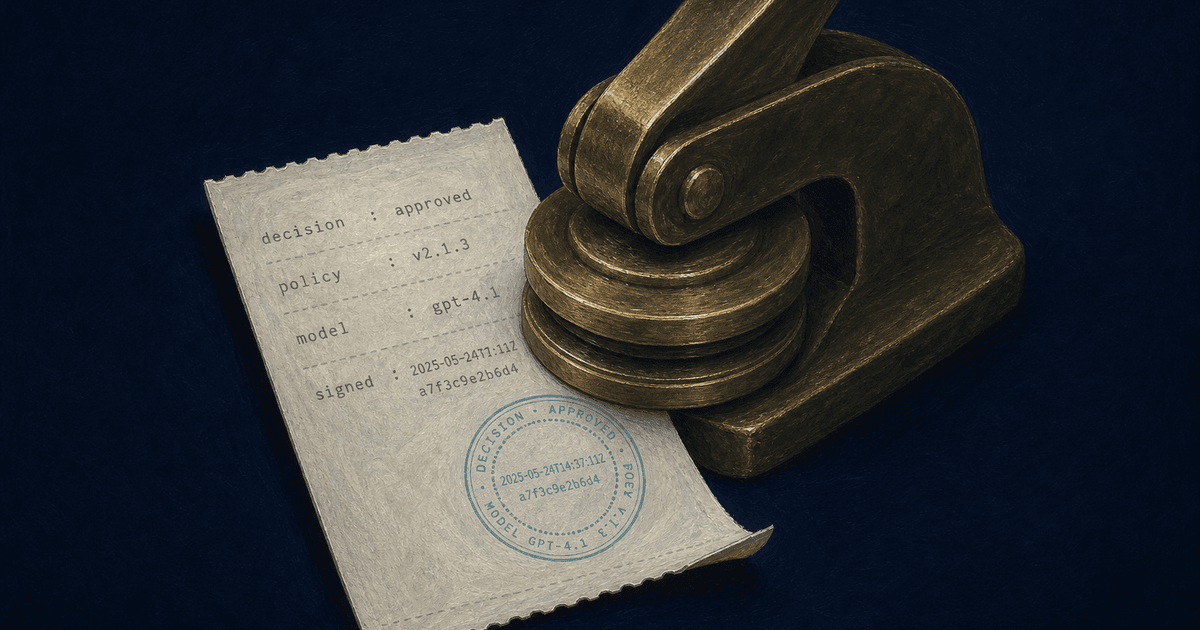
The point is to make every AI decision commit to itself, before it acts. That single primitive, applied across an industry, changes what is possible. We call it a receipt.
I. Bookkeeping for Machines
In 1494, the Franciscan friar Luca Pacioli published a textbook describing a curious accounting practice used by Venetian merchants. For every transaction, the merchant wrote two entries: one as a debit, one as a credit. The sum of all debits had to equal the sum of all credits. If they ever diverged, the books were wrong, and you knew immediately where to look.
Double-entry bookkeeping did not make trade faster. The same goods crossed the same seas. What it did was make trade legible across strangers. A merchant in Venice could extend credit to a merchant in Bruges he had never met, because the bookkeeping made the exposure visible and the trust mechanical. Within two centuries, the practice underwrote the rise of joint-stock companies, the Dutch East India Company, the Bank of England, modern insurance, and ultimately the financial system that funded the industrial revolution.
The lesson is not about ledgers. It is that a small primitive, applied across a domain, can change what kinds of cooperation are possible.
AI today is in the position of pre-Pacioli commerce. Every model deployment is a private negotiation. Each party relies on the one before it: the record is assumed complete, the assumption is inherited, and nothing has been edited as far as anyone can tell. None of the trust is mechanical. All of it is promises.
When something goes wrong, the questions a regulator will ask are the questions a Venetian merchant in 1493 could not answer: what was the model asked, when, by whom, under which policy, and with what result? The screenshots in today's compliance binders cannot answer these questions in a form that survives independent scrutiny. They are the same artefacts Pacioli's contemporaries used, and they will fail for the same reasons.
What would the present-day equivalent of double-entry look like for AI?
It would be a record produced by the model's own runtime, not by a human after the fact. It would be cryptographically signed, so that any tampering is detectable by any reader, not just by the vendor. It would commit to the exact prompt, the exact policy in effect, the exact model version, the exact response, at the exact moment. It would be portable across vendors and clouds, so that a hospital running its AI on AWS today and Azure tomorrow does not lose its audit trail. And it would be verifiable offline, by anyone with the public key, in a form a regulator's laptop can run without phoning home to the vendor.
This is what we mean by receipt. The cryptography is invisible plumbing. What matters is the social fact the receipt makes possible: a regulator who never met the bank can now audit what the bank's AI did, in a form the bank cannot edit.
Cloud audit logs are signed and timestamped, but each is single-provider, post-execution, and shaped by the vendor that runs it. A receipt is cross-provider, pre-execution, regulator-shaped, and bank-portable. It travels with the decision and is verifiable on the regulator's laptop in the same format across any cloud.
What does receipt-format consensus look like? Today, every cloud has its own audit log schema. A regulator overseeing AI in finance, healthcare, and the public sector faces three formats with three trust models. What would it take to converge on a single verifier, the way every browser converged on TLS?
What is the shape of evidence that survives an adversarial proceeding? A screenshot does not. A signed receipt with a hash chain might. No case law confirms it yet, which is precisely what makes it worth building for.
What does a receipt look like for a model that does not know what it did? Foundation models are non-deterministic. The receipt cannot reproduce the answer; it can only commit to the inputs, the policy, and the output as observed. That is a new epistemic object, and its boundaries are not yet drawn.
The three questions above are not rhetorical. They are the questions we work on, with concrete artefacts (open spec, conformance suite, ZK research, post-quantum migration plan) on the research page.
II. The Aesthetic of Evidence
Pre-commitment changes what evidence means: a forecast dated and signed before the outcome carries a different epistemic weight than one written after. Dating does not improve a forecast. It changes what the forecast is allowed to mean.
On 9 May 2026 AqtaBio, our outbreak-forecasting product, committed a public forecast ranking DR Congo Ebola position 4 in the Congo Basin biome. WHO declared a DR Congo Ebola PHEIC on 17 May, an eight-day lead, verifiable by anyone via public git log against the WHO date. The signal does not generalise: see the working paper for the explicit p-value, denominator, and what this single match licenses us to claim.
This is what we mean by the aesthetic of evidence. Not all evidence is equal in shape. A document produced after the outcome can fit any narrative; a document produced before constrains the narrative it can fit. Receipts make this distinction mechanical and public, instead of social and disputable.
Receipts give AI a kind of taste: the taste to know which things are worth committing to in advance, in what form, and on what evidence terms. A forecast worth making is a forecast worth dating. A decision worth automating is a decision worth signing. A claim worth trusting is a claim worth verifying without trusting the claimant.
The implications run further than they first appear. Receipts make cross-border claims auditable: a multinational pharma trial in Germany can be re-verified by an Irish public-healthcare auditor without re-running it. They make cross-time claims credible: a prediction from 2026 verifiable in 2036 still has its original signature. They make cross-vendor claims portable: when a bank migrates its model from AWS to Azure, the receipts come with it.
How do we keep receipts human-readable while machine-verifiable?A regulator's counsel must be able to read a receipt aloud to an oversight body. A model engineer must be able to verify ten thousand of them per second. These are different requirements imposed on the same artefact.
What does an AI-readable corpus of evidence look like, ten years from now? If every regulated AI action since 2026 produced a receipt, what does a 2036 oversight body do with that corpus? What does a 2036 regulator do with the patterns inside it? We do not yet have the tools to read evidence at that scale, and the tools we build will determine which questions can be asked of the record.
What is the proof artefact for an automated decision? A doctor signs off on a chart with their name. A judge signs off on a ruling with their seal. An AI signs off on its action with what? We think the answer is a receipt that names the human policy the AI was operating under and the cryptographic identity of the inference, jointly. Neither alone is sufficient.
If our manifesto has an aesthetic argument it is this: the shape of evidence determines the shape of trust. A field that does not yet have its verifiable primitive is a field where cooperation is constrained by the wealth of the strangers involved. Aqta is trying to build the primitive that makes AI cooperation cheap across strangers.
III. Cooperative Trust at Machine Speed
Regulated industries are not slow because they are stupid. They are slow because the cost of being wrong is asymmetric, and they have, until now, had no mechanism for trust that is cheap and durable at machine speed.
A bank deploying a new model takes months to satisfy three different parties: the model vendor, the bank's own risk committee, and the regulator. Each party operates on artefacts the other two distrust. A hospital deploying clinical-decision support takes the same months for the same reasons, with a different alphabet of regulators. A public agency deploying anything is slower still. The friction is not technical. The friction is that every party in the chain has to take the previous party's word.
Receipts remove one source of that friction, not all of it. Legal review, procurement, model validation and security review all remain. What changes is the part that runs on one party accepting another's account: once a model emits a verifiable signed record of every decision, that link becomes a verification. The bank's risk committee checks the vendor's claim rather than accepting it. The regulator checks the bank's. An auditor, if it comes to that, checks the regulator's. On that one axis nobody has to be trusted, because the artefact is the proof.
All of which rests on one condition, and it is worth stating as a condition rather than a feature: the signer is not the subject. The system that made the decision is not the system that vouches for it. A model that certifies its own behaviour has produced a claim, not evidence, and an operator who signs their own record with a key only they control has moved the question rather than answered it. Every hard problem left in this field is a version of that sentence, which is why we treat the issuer as the adversary worth designing against, including when the issuer is us.
Designing against yourself has a cost, which is that you end up knowing exactly where your own instrument stops. Three limits, and we would rather write them here than have them found. A signature establishes that the issuer signed those fields and that none has changed since; it does not establish that the record matches the computation that physically ran, which is why our work runs towards evidence bound closer to the execution environment rather than towards louder claims about the signature. It does not establish completeness: a decision never written down leaves no trace of not having been written down, and anchoring in a log we do not operate narrows the window in which that can be hidden without closing it. And it establishes nothing at all about whether the decision was correct, fair or lawful, which are questions for other evidence and other people.
A primitive that claimed more than that would be the thing this essay is arguing against. Double-entry did not tell a merchant whether a venture was wise. It told him whether the books balanced, mechanically, in a way a stranger could check, and it turned out that was enough to change what commerce was possible between people who would never meet. We are making the smaller claim on purpose.
We are betting that the reduction in trust cost is large enough to change what AI gets deployed and where. If the bet is right, it shows up as clinical AI in hospital settings that currently cannot defend the audit story, as models in customer-facing bank decisions where the regulatory weight is presently prohibitive, and as public-agency AI in eligibility, scheduling and triage where the political weight is. We cannot know that any of it follows; it is the hypothesis, not the forecast. What we can say is what those deployments would not require. Not better AI. Better evidence.
The bet that runs through everything we build is that one receipt shape can cross the portfolio. The same signed record that dates an outbreak forecast also proves a redaction held and stamps a health reading on the phone in someone's pocket. Across the portfolio, one primitive:
- AqtaBio committed a public Congo Basin Ebola forecast on 9 May 2026: DR Congo at rank 4, eight days before the WHO PHEIC on 17 May, verifiable by anyone against the public git log (bootstrap p = 0.222; mechanism precedent, not a predictive claim). (Live, W19 precedent)
- Bounds Pro strips sensitive data on-device and keeps an on-device record of what it removed. (Live, public)
- Seal signs the load-bearing decision: a signed ATTESTATION-v1 record for every call it clears or blocks, verifiable offline against a published key, without trusting us. The claim-layer face of the same receipts primitive; not a separate company. The reference verifier is open-source on public registries. (Live, production)
- Testera is the educational case: adaptive coaching designed for transparency, with the basis for every recommendation traceable to the student's history. (Live, test prep)
Different domains, one primitive. We do not claim to be the only company that has noticed this, or that the cryptography is ours alone. What we claim is the combination, running in production: open verifiers on npm and PyPI, a published signing key, enforcement before the action executes, evidence shaped for the people who audit it, and a published threat model. Dated artefacts, in regulated industries.
Can a regulator's audit infrastructure scale to billions of AI decisions per day? Today's audit dashboards cannot. A receipt-shaped record can, because the verification is local and parallelisable.
What is the right accountability interface between many humans and many AI agents, when every interaction produces a receipt? This is the question we live within. We use Seal for our production AI calls, and we are extending the same routing to internal tooling. If the interface is wrong, we are the first to know.
How do we keep receipts cheap? Cryptography is not free. Storage is not free. If the receipt cost more than the inference, the primitive does not generalise. We have a target: receipt overhead below five milliseconds, receipt storage below the cost of the response. Below those numbers, receipts become the default. Above them, they remain a luxury.
The next decade of AI deployment will not be decided by who has the biggest model. It will be decided by who built the verifiable primitive that lets the biggest model be used in the places that need it. We are building that primitive. If you work on these questions, we should talk.
IV. The Industry Just Said It Out Loud
The IAPP AI Governance Global summit’s 4 June 2026 closing-day session, “Who Watches the Watchers: Governance for Human in the Loop,” framed the question the field has been edging toward. Here is how we would put it, and what we built Seal to answer.
Aqta position
When a human intervenes, the receipt names what they did, when, and against which policy. Without that, human-in-the-loop is theatre.
Our position does two things.
First, it sets aside model evaluation as the test. Benchmark scores are not what regulators examine. The framing that the AI itself is the thing under oversight is wrong.
Second, it names the actual test: human intervention effectiveness. Not policy on paper. Not oversight committee minutes. Effectiveness, demonstrable.
The receipt is the measurement primitive. Every passed decision signed. Every intervention timestamped. Every denial audit-logged. Every auditor can verify offline, against a published key, and the receipt stands.
Before the receipt, “we have human oversight” was a slide claim.
After the receipt, “human intervened at T+47ms, signed receipt 0x8f3a…d92c, verified against pubkey gUoUhIvptKAo…” (illustrative) is a forensic record.
The industry has now said it out loud. We have been building the answer for the question they just framed.
Write to us at hello@aqta.ai or find us on LinkedIn.
If your team is putting AI into a regulated workflow, apply for a pilot. Sandboxed, four to six weeks, a signed Evidence Pack at the end.
Since this was written
Since May 2026, Aqta has taken part in the first UN Global Dialogue on AI Governance in Geneva (July 2026) and attended IAPP AI Governance Global Europe in Dublin (June 2026), the summit referenced in Section IV. Revision 01 of the receipt format was posted to the IETF datatracker on 25 July 2026 as an individual Internet-Draft, not adopted by any working group. Aqta is an accredited participant at the International AI Summit under Ireland's Presidency of the Council of the EU (Dublin, 14 October 2026). All are recorded here as participation, not endorsement.
 Seal pilot